我们鼓励青少年用100个词讲述他们生命中一个有意义的时刻。以下是我们收到的14232篇“微型回忆录”投稿中的部分主题。
以下我们向73位入围者致敬:17位获奖者、19位亚军和37位荣誉提名者。这些文章,无论大小、感人或幽默,都深深打动了评委,寥寥数语便讲述了一个完整的故事。
阅读以下 17 部获奖回忆录,然后留言告诉这些年轻作者,他们的故事是如何打动你的。
祝贺入围决赛的选手,并感谢所有参与者。
Happy Halloween
I fidgeted in the car, adjusting my SWAT gear. We parked, ready for a sugar raid.
Dad shut the car door too soon.
Bam! Part of my finger went with it.
The back seat turned into triage. Mom tore off her Viking beard, wrapping it tight around my finger. My sisters cried as if they lost their fingers. Dad searched the car for my fingertip, nothing.
Relief settled in on the way back from the E.R. It would heal, the doctor said.
Two years later, the car has new owners. If they find what we failed to … well, happy Halloween.
— Aiwen Abels, 15, Urbana High School, Ijamsville, Md.
Unopened
Your Christmas gift to me sits unopened on my desk, next to the one I wrapped for you.
We joked about forgetting to exchange them, promising we’d “definitely remember next time.”
Your mom mailed yours to me after the funeral.
Some nights I sit and stare at them. Two little boxes, a tiny museum of the life we were supposed to keep living together.
I think, Open it. Go. Do something.
My hands stay still.
It feels like once I tear the tape, our friendship will collapse into a moment in time.
So the gifts stay closed. You stay close.
— Aanya Singh, 16, Collegiate School, Richmond, Va.
The Ledger
We never said “I love you.” We said “the faucet drips” and “the computer crashed.” Our language was a ledger of deficits.
After Dad went abroad, I found his notebook. Page after page of our coded language. My handwriting next to his: “Gutter clogged.” “Balcony door sticks.” “Lightbulb is out.”
On the last page, a new entry, in his shaky script: “Daughter’s room window — may leak in heavy rain.”
Beneath it, left blank.
I found a pen. I did not write an answer. I drew a check mark.
Received. Understood. Loved.
— Shuyu Zheng, 16, home-schooled, Ningbo, China
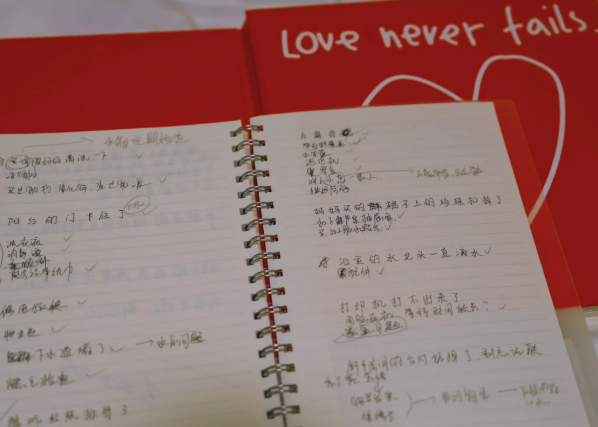
A notebook filled with handwritten notes about small household repairs and everyday details.Credit...Shuyu Zheng
Watch Three Times
My Instagram feed is great. The golden retriever is silly. I heart it. The woman is upcycling a shirt into a bag. I heart it. The man has a child. There is crushed concrete and he is crying. Please share. Please like. I don’t know what to do. I heart it. I watch twice. I don’t know what to do. I scroll. There is a woman. The flour is full of rocks. Press all the buttons. I don’t know what to do. I heart it. I copy the link. I watch three times. I — I turn off my phone.
— Daisy Luke, 16, North Hollywood High School, North Hollywood, Calif.
Baby Shark
Everyone told 5-year-old me that fishing would be boring. “You’ll sit around all day and won’t catch anything,” they said. “Don’t get discouraged.” So, I cast my line and prepared for nothing.
Minutes later, I felt a tug and thought I’d imagined it. Then the fin appeared. I reeled in my first catch: a baby shark, twisting and splashing like it couldn’t believe it either.
The adults stood frozen. I felt like a legend, knowing this was the highlight of my fishing career.
That day, I retired my fishing pole because once you catch a baby shark, doo-doo-doo-doo-doo-doo, you’re done.
— Danny Unatin, 13, Manhattan Beach Middle School, Manhattan Beach, Calif.
The Em Dash Love Affair
At the back of computing class, a miracle occurred. Alt+0151, the em dash, was discovered on my clickety-clackety keyboard of 2017. Elegant and flamboyant, it instantly eclipsed the uninspired hyphen. I typed it everywhere, often incorrectly, flaunting my punctuation prowess. I loved it with every keystroke.
Five years later, A.I. arrived. Essays in minutes? Sign me up. “Look! An em dash — even ChatGPT uses it,” I bragged.
Now the editor of the school’s newsletter, I spot an em dash and delete it. My beloved dash, once regal, is canceled, a hallmark of copy-paste A.I. writing. Back to the tasteless hyphen.
— Jannah Nuzraan, 17, UTS College Sri Lanka, Colombo, Sri Lanka
Vitamin C Diplomacy
You, brandishing the overbearing medal that is motherhood.
I, donning the colorful sash that is teenage hostility.
Topic of the day? Independence! Union with The Friends! Freedom from Maternal Control!
First, distract the enemy; cite Washed Dishes from four nights ago. That’s not enough? OK … what about Honor Roll from four years ago! Still not enough?
Time for the Final Stand. Slam room door, yell obscenities. Viva la Revolution!
Postwar. As The Friends convene over FaceTime, the door opens with a diplomatic offering.
Delicate spirals of H Mart oranges on porcelain, a symbol of peace.
Defeat never tasted so sweet.
— Caroline Zhang, 16, Canadian International School of Hong Kong, Aberdeen, Hong Kong
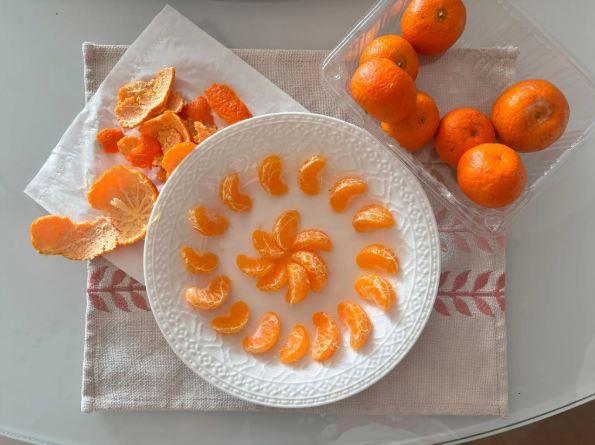
“One of the many orange spirals my mother has made over the years. Though we no longer live in the States, an orange tastes sweet everywhere and anywhere.” — Caroline ZhangCredit...Caroline Zhang
Aftertaste
I hate the taste of charcoal.
It clung to my tongue. I kept my mouth shut. The nurse handed me a menu. My mother slept in the chair beside me, still wearing scrubs, as if she’d run straight from work to my dying.
I ordered her pancakes. Fruit. Ginger ale. Pathetic attempt at an apology.
The IV clicked steadily; it did not care for my regret.
She woke up and stared at me for the longest time, counting every version of me she ever loved.
She asked, Why?
I couldn’t answer. Not for two years.
I cried instead.
— Peace, 16, West Orange High School, West Orange, N.J.
If you are having thoughts of suicide, call or text 988 to reach the 988 Suicide and Crisis Lifeline or go to SpeakingOfSuicide.com/resources for a list of additional resources.
Pictures Not Taken
As a child, I spent summers with my grandparents, lost in video games and never satisfied with the limited playtime for minors. I told my grandmother I wanted to take pictures of her, but it was only for ID checks to extend my gaming time. Each time, she straightened her weak legs and smiled patiently at the camera. I smiled back, eager to return to my screen. I never truly took her picture. After she passed, my grandfather asked if I still had those photos. He remembered her posing for them. I froze. I had nothing to give — only regret.
— Jimmy Liu, 15, Northfield Mount Hermon School, Gill, Mass.
Payless Shoes
His hair looked like it had lost a fight with a blender. Off-brand shoes. We laughed. Poked. Prodded. He chose his moments, speaking rarely but with benevolence. Somehow, I ended up in his dim, worn-down house. We stepped through the door, and his mom beamed, “Honey, how did the kids at school like your new shoes?” He slipped into his joyful facade, “They loved them.” She glowed. I held the truth of our laughing and mocking in a solemn silence. I never told her, or anyone, and I never forgot that moment. I never saw him the same.
— Nathan Marchand, 16, Worcester Academy, Worcester, Mass.
Call Me Smurf
In seventh grade, my frenemy Leon started calling me “Smurf.”
Shortest Japanese kid in school. Fast legs. Blue polo shirt. Squeaky voice.
The name stuck.
When we ran against each other for G7 student council, he smirked,
“Too small to lead.”
Thanks for the marketing slogan.
My campaign video: “Call me Smurf — small but mighty.”
I zoomed around campus, “besting the bullies,” and somehow won the most votes.
Now I’m five foot nine — not tall, but tall for a Japanese kid.
Napoleon was shorter, yet conquered half of Europe.
My years of being short still push me to win big.
— Kazushi Kousaka, 16, Choate Rosemary Hall, Wallingford, Conn.
Once Upon a Time …
I was the hottest commodity in my elementary school in Korea. Kids were drawn to my exotic, tongue-twisting birth place (Massachusetts), while mothers were drawn to my rudimentary Korean (and perfect English). For me, it was heaven: afternoons full with playdates, new best friends every week, and an armful of friendship bracelets.
Then one day, a new student transferred from France, with an accent like molasses. Suddenly, I became passé: Cambridge, Massachusetts, had nothing on Clermont Ferrand, France, and my American English was crude next to her posh French. At the age of 7, I had already become a has-been.
— Mari Kang, 15, Lexington High School, Lexington, Mass.
Move Mountains
It’s dark out when I wake up. Mom is asleep on the couch by the window, near the “Get well soon” cards that feel more like questions than wishes. Dad is in the recliner, playing Minecraft. I make eye contact and mouth a few words to him. He nods, handing me a purple iPad; he knows the drill. As I log onto our realm, I feel a large flush of gratitude. Sure, I can’t leave this small hospital room, and sure, I can’t really breathe. But here, with my dad, tapping a smooth smudged screen, I can move mountains.
— Eloise Franck, 13, Seattle Girls’ School, Seattle
The Color I Learned to Carry
Recess was my favorite part of the day. I loved tag the most, the rush of running, the slap of sneakers against the pavement, and the joy of being included in something fast and free. That afternoon, I saw some kids running around the playground. I ran after them, smiling, sure I had found my next game. As I reached out to tag one of them, they turned, shouting, “Blackie, Blackie!” Their voices cracked like twigs, sharp and sudden, but I didn’t understand. I laughed too, screaming, chasing them, playing with them, thinking it was all part of the fun.
— Temi Adebowale, 16, St. Mildred’s-Lightbourn School, Oakville, Ontario
Not Tonight
After midnight, my mother’s headlights carve a narrow path through empty streets. The delivery bag on my lap warms my legs, heavier with each order. Her phone rings again — another address, another few dollars. I see her wedding ring catch the light as she tightens her grip on the wheel, tired but steady.
We usually say yes. We usually don’t think. But tonight, the hush between rings feels different. Homework waits; exhaustion waits harder.
I hold the bag, breathe once, and say it quietly, almost to myself:
“Not tonight.”
— Junjie Yang, 16, Diamond Bar High School, Diamond Bar, Calif.
Do I Not Know Earthquake Protocol?
As a Chilean immigrant at a new American school I clung to the few things I understood. So, when the alarm went off and I heard “drill,” my mind leaped to earthquake protocol.
Told to get under the desks: Check. Earthquake.
Blinds were drawn: Unknown. How would we see?
The door locked: Unknown. Why would we trap ourselves in?
Desks piled against the entrance: Unknown.
My teacher whispered, “Quiet. Just in case someone was out there.” Unknown.
No earthquake, but someone?
A classmate saw my confusion and mouthed one word: shooter.
I quieted. At least I now knew another drill.
— Valentina Nicole Fuentes Jimenez, 17, New Canaan High School, New Canaan, Conn.
For When I Come Home
The last time I flew back to Shanghai, it had been longer than usual — months stretched thin by schoolwork and distance. My grandma beamed when I appeared in the doorway. She held out a small carton of my favorite Chinese sweet milk.
I took a sip and spit it out.
“Ugh, it’s expired!”
She blinked, confused. “I can’t read this small writing,” she murmured. “I saved them for you. I just didn’t know you would take so long to return …”
Behind her, I noticed a whole row stacked neatly by the rusty kettle. Dozens of them. All waiting. All expired.
— Yuhan Wu, 16, Middlesex School, Concord, Mass.
All Finalists
In alphabetical order by the writer’s first name
Winners
Aanya Singh, 16, Collegiate School, Richmond, Va.: “Unopened”
Aiwen Abels, 15, Urbana High School, Ijamsville, Md.: “Happy Halloween”
Caroline Zhang, 16, Canadian International School of Hong Kong, Aberdeen, Hong Kong: “Vitamin C Diplomacy”
Daisy Luke, 16, North Hollywood High School, North Hollywood, Calif.: “Watch Three Times”
Danny Unatin, 13, Manhattan Beach Middle School, Manhattan Beach, Calif.: “Baby Shark”
Eloise Franck, 13, Seattle Girls’ School, Seattle: “Move Mountains”
Jannah Nuzraan, 17, UTS College Sri Lanka, Colombo, Sri Lanka: “The Em Dash Love Affair”
Jimmy Liu, 15, Northfield Mount Hermon School, Gill, Mass.: “Pictures Not Taken”
Junjie Yang, 16, Diamond Bar High School, Diamond Bar, Calif.: “Not Tonight”
Kazushi Kousaka, 16, Choate Rosemary Hall, Wallingford, Conn.: “Call Me Smurf”
Mari Kang, 15, Lexington High School, Lexington, Mass.: “Once Upon a Time …”
Nathan Marchand, 16, Worcester Academy, Worcester, Mass.: “Payless Shoes”
Peace, 16, West Orange High School, West Orange, N.J.: “Aftertaste”
Shuyu Zheng, 16, Ningbo, China: “The Ledger”
Temi Adebowale, 16, St. Mildred’s-Lightbourn School, Oakville, Ontario: “The Color I Learned to Carry”
Valentina Nicole Fuentes Jimenez, 17, New Canaan High School, New Canaan, Conn.: “Do I Not Know Earthquake Protocol?”
Yuhan Wu, 16, Middlesex School, Concord, Mass.: “For When I Come Home”
Runners-Up
Alina Ahmed, 15, Plymouth High School, Canton Township, Mich.: “A Survivor’s Embrace”
Chaebeom Lim, 17, Darlington School, Rome, Ga.: “66 Pounds of Hope”
Cooper Rogers, 17, James I. O’Neill High School, Highland Falls, N.Y.: “Could Be Worse, Could Be Raining”
Daphne Kelly, 13, German International School of Portland, Beaverton, Ore.: “Follow Your Heart”
Elara Friedman, 15, Professional Performing Arts High School, New York City: “Un Vrai Moment New-Yorkais”
Elizabeth Turner, 14, Bryn Mawr School, Baltimore: “The Things You Do for Friendship”
Ellie Xu, 16, Walt Whitman High School, Bethesda, Md.: “The Dog Who Cried Rain”
Emily Long, 13, Meadowlark School, Erie, Colo.: “The Day My Croc Took Flight”
Hera Kashahu, 15, Albanian International School, Tirana, Albania: “Rules Change”
Hiya Goel, 16: “Running From Pink”
Jane O’Connell, 17: “The Bloom He Nearly Crushed”
Jia Ying Wu, 18, Taipei First Girls High School, Taipei, Taiwan: “Miss Me Not”
Kierra Brauhn, 15, Cherokee Trail High School, Aurora, Colo.: “Fluidity of My Identity”
Isaac Wang, 14, Sycamore High School, Montgomery, Ohio: “Two Worlds”
Li ZhiYun, 16, Guangzhou, Guangdong Province, China: “Where We Hid Christmas”
Maya Groch, 18, Solebury School, New Hope, Pa.: “Not My Sun”
Sophia Chen, 13, Masterman School, Philadelphia: “The Bolt”
Tara, 16, Phoenix Country Day School, Paradise Valley, Ariz.: “What They Saved, What I Lost”
Zhu Jia, 15, Shanghai High School, Shanghai: “The Lift”
Honorable Mentions
Ahmed Mahmoud Allam, 17: “Tiny Memoir”
Ailyn Diaz, 16, Hayward Twin Oaks Montessori School, Castro Valley, Calif.: “Night Shifts”
Alexa Levitt, 14, BASIS Independent Manhattan Upper School, New York City: “Where Our Branches Used to Be”
Aliya Leon, 16, Santa Rosa High School, Santa Rosa, Calif.: “A Different Kind of Hunger”
Amelie Theunissen, 14, Brookline High School, Brookline, Mass.: “Forever Pinky Promise”
Araceli Morales Arce, 15, Woodburn High School, Woodburn, Ore.: “Our Silent Secret”
Ariana Fard, 14, Loyola Academy, Wilmette, Ill.: “Pass the Toothpaste”
Benjamin Charkosky, 16, Lakewood High School, Lakewood, Ohio: “The Word I Didn’t Know”
Boyang Sun, 14: “Turning Into a Joker on April Fools’ Day”
Charlize Sitto, 16, St. Catherine of Siena Academy, Wixom, Mich.: “5,000 Miles Can’t Be That Far …”
Chloé Haygood, 16, The College Academy at Broward College, Davie, Fla.: “The Chemistry of Confidence”
Holden Mccarter, 13, Bonny Eagle Middle School, Buxton, Maine: “Going to the Punk Rock Show”
Huong Luong, 17, Worcester Academy, Worcester, Mass.: “The Cool Girl Mishap”
Ismarcis Ponce Cruz, 16, Archer School for Girls, Los Angeles: “Absence”
Isra, 15, Canterbury High School, Fort Wayne, Ind.: “The Pretty One”
Jayati Babla, 15, Francis Parker School, San Diego, Calif. “My Mother Tongue”
Jessica Osinachi, 19, Nigeria: “The Shirt He Never Wore Again”
Jiufeng Shang, 13, Jonas Clarke Middle School, Lexington, Mass.: “Pocket Stones”
Justin Cheong, 16, North Hollywood High School, North Hollywood, Calif.: “Five Stories Up”
Kaia Richardson, 13, Walsh Middle School, Round Rock, Texas: “Coming Home”
Kevin Hu, 17, Beijing National Day School International Department, Beijing: “Shatters”
Lidya Fisha, 16, Northwestern High School, Hyattsville, Md.: “Between Two Worlds”
Madelyn Terry, 14, Marblehead High School, Marblehead, Mass.: “The Question”
Mary Sulollari, 16, Northville High School, Northville, Mich.: “A Toothpick for Uncle Lilo”
McKenna Chang, 16, Henry M. Gunn High School, Palo Alto, Calif.: “Say Cheese!”
Michelle Kim, 16, Newport High School, Bellevue, Wash.: “Ddok Ddoki (Knocking)”
Mihir Anil, 15, Timberline High School, Boise, Idaho: “Zenith of Instrumental Tensions”
Natalie Huang, 13, Hillside Middle School, Northville, Mich.: “Silence in the Abyss”
Nisa Thomas, 16, Del Norte High School, San Diego, Calif.: “What Google Couldn’t Translate”
Samantha Gavin, 15, Beacon High School, New York City: “The Embrace”
Sarang Kim, 13, Gaepo Middle School, Seoul: “Left Hand”
Seyun Kim, 17, Gyeonggi Science High School for the Gifted, Suwon, South Korea: “A Beginning Without Words”
Soh Han Joanna, 15, Raffles Girls’ School (Secondary), Singapore: “Grief in Advance”
Summer Hsu, 15, National Cathedral School, Washington, D.C.: “Boys Will Be Boys”
Jin Ye (金烨尘), 13: “The Day I Learned to Fly”
Yujin Um, 17, Shepherd International Education, Seoul: “Wild Fire”
Zoe Armstrong, 15, Benjamin N. Cardozo High School, Queens, N.Y.: “Modern Day Cinderella”