2026-2027《纽约时报》系列写作竞赛时间轴发布!两大新规严格限制AI!

《纽约时报》系列学生写作竞赛被誉为全球中学生的“写作奥林匹克”,旨在鼓励全球13-19岁的中学生洞察世界、独立思考并清晰表达观点。2026-2027赛季共涵盖七项核心赛事,覆盖写作、音频、视频、视觉艺术等多种形式。

一、 2026-2027赛季《纽约时报》系列写作竞赛时间轴

学生可根据自身特长,在赛季内参加任意数量的比赛,但每项比赛仅限提交一份作品:

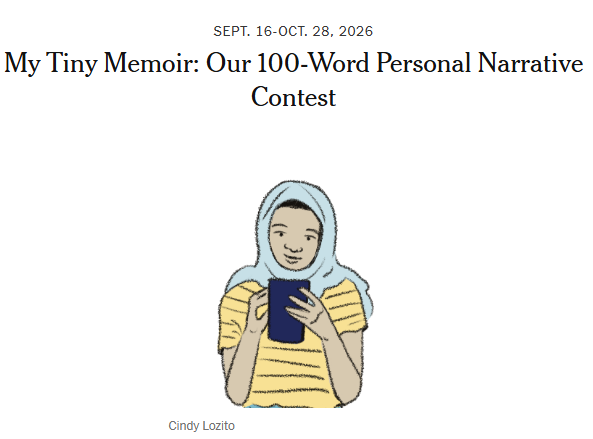
My Tiny Memoir(百字回忆录):

赛事日期:2026.09.16 - 10.28

本比赛灵感来自纽约时报Modern Love专栏著名的Tiny Love Stories(微爱情故事)。

要求用仅100个英文单词讲述个人生活中的重要经历。

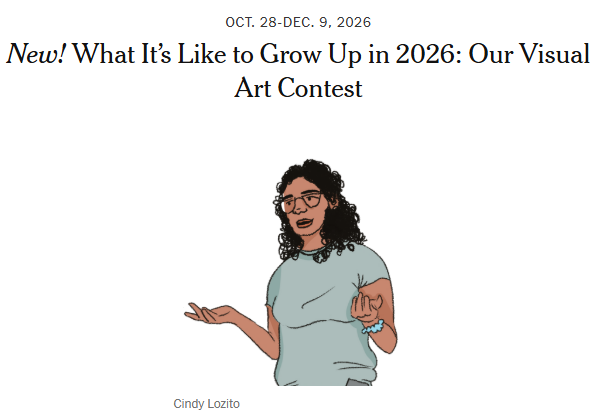
What It’s Like to Grow Up in 2026

成长于2026视觉艺术赛:

赛事日期:2026.10.28 - 12.09

现在做一名青少年是什么样的体验?
你们这一代人面临哪些独特的挑战?
2026年的世界为年轻人提供了哪些特殊的机遇?

今年,纽约时报长期举办的 Coming of Age(成长)系列比赛首次仅接受视觉艺术作品。

作品形式不限,包括:摄影,绘画,油画,漫画,图表,数据可视化,截图,短片,雕塑或几乎任何能够拍照上传的视觉作品。

提交作品时,还需附上一份艺术家说明,记录你的创作过程,并阐述作品如何与上述三个核心问题相关联。

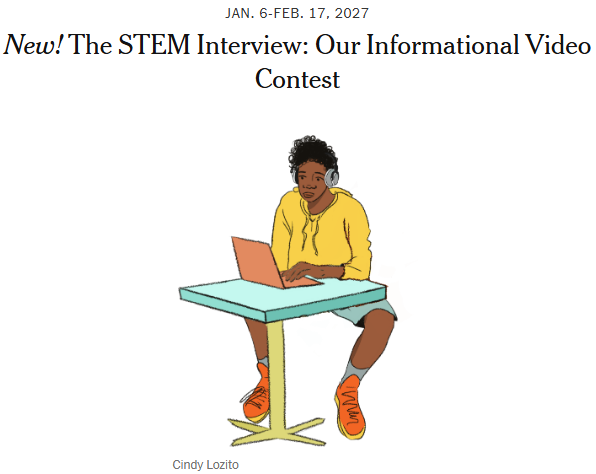
The STEM Interview

STEM访谈视频赛:

赛事日期:2027.01.06 - 02.17

制作2分钟以内的原创视频,采访相关领域专家以解答科学、技术或工程问题1。

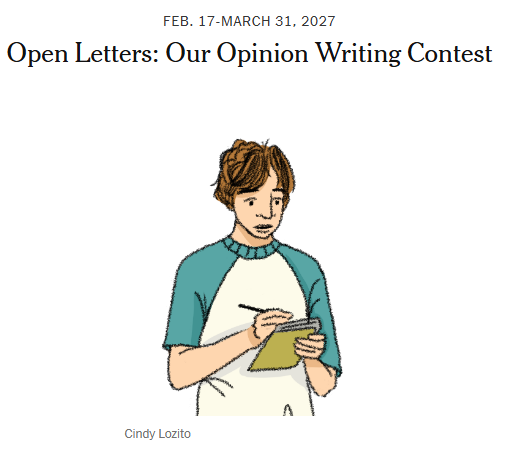
Open Letters

公开信观点写作赛:

赛事日期:2027.02.17 - 03.31

撰写不超过500词的抗议信或呼吁信,写给能够推动社会改变的人或组织。

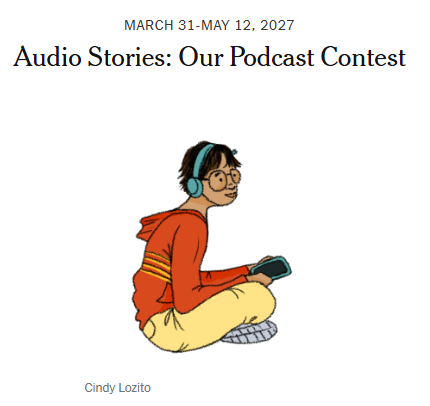
Audio Stories

音频故事播客赛:

赛事日期:2027.03.31 - 05.12

制作一段5分钟以内的原创播客,主题与形式不限。

Voice and Choice: Summer Reading

夏季阅读赛:

2027年6月至8月(共三轮)

重大赛制调整:2027年该赛事缩减为仅在6月、7月和8月各举办一轮(共3轮),而非以往的10轮。每月需提交短文或90秒视频回应“本周《纽约时报》哪篇内容最吸引你”。

Current Events Conversation

每周时事讨论:

全学年持续开放。学生可每周针对每日写作话题发表观点,优秀作品将被专栏展示。

二、 2026-2027赛季纽约时报写作竞赛“反AI”硬核新规

在生成式AI泛滥的时代,纽约时报今年对AI使用政策进行了极其严格的升级,违规作品将被直接取消评审资格:

全面封杀生成式AI:严禁使用任何AI工具(如ChatGPT、MidJourney等)生成、修改、润色或翻译作品。无论是文字、图片、音频还是视频,均不得包含AI生成或增强的内容。

创作过程纳入正式评分:评委不仅看最终作品,还会评估学生的创作记录与反思。例如,书面作品必须在Google Docs中从头至尾完成并分享,以便评委通过“版本历史记录”查看从初稿到终稿的修改过程。

三、 参赛资格与评审机制

参赛门槛:面向全球13-19岁的初高中生(以提交作品当天年龄为准)。作品必须为全英文原创,未在任何公开平台发表过。

匿名评审:所有比赛均由《纽约时报》编辑、记者及教育工作者进行匿名评审,评委无法看到学生或学校信息,确保绝对公平。

结果公布:通常在每项比赛结束后的2-3个月公布,获奖作品将发表于《纽约时报》Learning Network页面,且作者保留作品版权。

NYT竞赛往年优秀作品扫码免费领取【可提供报名服务】

2026年纽约时报夏季阅读比赛获胜者

每年夏天,在为期 10 周的时间里,世界各地的青少年都会受邀回答以下问题:“本周《纽约时报》的什么内容最让您感兴趣?” 以下是最受官方喜欢的答案:

夏季阅读比赛第 6 周获胜者:On National Parks and Brainrot

夏季阅读比赛第 5 周获胜者:On Cats, Dystopian Novels and Sleep

夏季阅读比赛第 4 周获胜者:On Literacy Struggles and Sleeping Fish

夏季阅读比赛第 3 周获胜者:On Gen Z Movies and Walking to the World CupSpaceX and the World Cup

夏季阅读比赛第 2 周获胜者:SpaceX and the World Cup

夏季阅读比赛第 1 周获胜者:The Knicks, Memes, Family Secrets and Clavicular

更多获奖作品我们将持续更新

夏季阅读比赛第 6 周获胜者:On National Parks and Brainrot

本周是为期十周的挑战赛的第六周,我们收到了1244份投稿,并选出了 两位获奖者,分别是 Chenyi ZhuChristopher Leung 的文章。 你可以在下方欣赏他们的作品。

Our Winners

Chenyi Zhu, 15, from Pleasanton, Calif., talked about “Going to a National Park This Summer? Here’s What to Expect.” She wrote:

“Going to a National Park This Summer?”

Yes! I’m very much looking forward to taking my brother to the same parks that I explored when I was his age!

“Here’s What to Expect.”

It’s a quiet place where you can get away from the crowds and—

“Huge visitor numbers”

What about the volunteers who teach the science and history of the land? Higher visitor flow, so surely they’re not gonna keep reduc—

“sharply reduced staffing”

How are they gonna handle reserva—

“scrapped reservation systems”

What’s next, higher prices for foreigners?

“higher entry fees for nonresidents”

At least my brother can get the 4th grade pass, with its beautiful park scenes as the design— is that Trump?

Many things have changed since I first visited a national park, many of which the article didn’t cover. The wonder I felt about the science and history of sequoias remains, but my memories no longer reflect reality. Signs on scientific and historic issues have been removed. People are told to report similarly “negative” signs. Parks are pushed to be less woke. Free-for-everyone days became free-for-“patriotic”-residents-only. Nonresidents now pay nearly triple.

National parks are no longer the sanctuaries that I knew. They’ve been cheapened, dumbed down, no longer worth a visit … or are they?

The question lingers as I look out the car window beside my brother. I smile, recognizing where my parents have brought us for the weekend.

Where I first stepped into a place worth protecting:

Sequoia National Park.

Christopher Leung, 16, from Jericho, N.Y., responded to “Test Your Internet Brain. Can You Use ‘Choppelganger’ in a Sentence?” He wrote:

AP scores came out just over a week ago. Chat, is it safe to say I’m cooked? My academic aura is already falling off, and now college board is about to hit me with a generational debuff. When I finally clicked on the “check your scores” link, it turns out my scores weren’t just cooked, they were deep fried and served with a side of copium. My college chances are on life support, while my delusion stats are maxed out thanks to those who know.

The article “Test Your Internet Brain. Can You Use ‘Choppelganger’ in a Sentence?” made me lock in.

It taught me a new word, Choppelganger, which is the combination of the slang “chopped” and “doppelganger”. Basically meaning someone who looks like you but just worse looking. Similar examples of this word prove how fast unconventional words can be popularized. Proving we can unofficially invent new vocabulary through word of mouth.

These slang words are living proof of the evolution of the English language. While most people dismiss these words as meaningless nonsense, I see it as the most compelling proof that the English language truly has no limit.

Modern human language was shaped by Shakespeare’s coining of words like “swagger,” “bedroom,” and “lonely.” And although it sounds ridiculous, modern Gen Z slang is following the same path, pioneering language history as we know it.

Maybe a couple hundred years from now, students will study brainrot the same way we study Shakespeare today.

Runners-Up

Amalie Bagaria on “What 370,000 College Essays Tell Us About A.I.’s Effects on Creativity.”

Doyun Kim on “How Wall Street Turned Its Back on Climate Change”

Hyomin Yeo on “The Metropolitan Diary Challenge”

Isabella Liu on “Colombian Immigrant Killed by ICE in Maine Had Legal Status, Father Says”

Justin Wang on “Sizzling, Sexy Age-Gap Romance Novels”

Owen Kim on “How ‘Age Tech’ Might Help You Grow Old at Home”

Roy Wang on “What Does Dressing Up Mean Today?”

Shuwei Jiang on “When the Male Gaze Turns on Men”

Yiqing Laura Lu on “Building Nests Is Hard. That’s Why Some Birds Steal”

Honorable Mentions

Aahana Mukhi on “Sites Unseen: What’s Revealed by Traveling With the Blind”

Alyssa Schonfeld on “This Kind of Obsessive Attraction Isn’t Love. But it Has a Name.”

Brian G. on “I’m a Therapist. Not Everyone Should Be in Therapy.”

Charlotte Cipriani on “Afghans Hold Rare Public Protests Against Taliban Rules”

Derek Kang on “California’s Plastic Law Goes to Court: Is It Too Strict or Too Lax?”

Devin Zhou on “Meta Unveils an A.I. Image Generator”

Eric Wang on “A Bird’s Brain Holds Clues to the Sounds of Music”

Eric Zhou on “Our Never-Ending Race to the Bottom”

Eva Manna on “The Constant Work to Keep a Family Connected Has a Name”

Glynnis Gravador on “A Conservative Role Model for Ending the Fertility Crisis”

Helen Dai on “The Revenge of the Philosophy Majors”

Hugo Yu on “America Marks Its 250th Birthday With Storms, Sweat and Fire”

Irene Lin on “Humans vs. Bots — Who Does the Em Dash Better?”

Jaein Kim on “We Are Losing the Ability to Discover What We Didn’t Know to Ask”

Jaekyeom Kim on “How Does One Brain Speak Two Languages?”

Jeongwon Kim on “The 39-ish Most Stylish People of 2026, So Far”

Julia Yi on “Everything’s Bananas”

Mandy Lin on “Life Is Better With Siblings”

Sid Sharma on “Why Are Berries Everywhere, in Every Season? Driscoll’s.”

Woosung Chun on “As the World Cup’s stakes rise, hotel prices keep falling”

Zhenrui Peng on “We Are Losing the Ability to Discover What We Didn’t Know to Ask”

夏季阅读比赛第 5 周获胜者:On Cats, Dystopian Novels and Sleep

第五周,我们收到了1133份投稿,最终评选出获奖作品:Runhu Xu 的视频作品和Penelope IrwinClarissa Tick 的两篇散文。你可以在下方欣赏所有作品。

Our Winners

Runhu Xu, 15, from Bellevue, Washington, muses on the Modern Love essay “Men, Hide Your Cats” in the video above.

视频地址:https://www.youtube.com/watch?v=IMZ_CuXSUWM

Penelope Irwin, 15, from Guilderland, N.Y., got hooked on a podcast episode called “I Keep Telling People We’re Living in This Dystopian Novel.” She writes:

Because my dad is the world’s most stereotypical humanities professor, he makes me listen to The Ezra Klein Show whenever we’re in the car. I’ll argue, groan, and pointedly look out the window until he switches to his favorite The Mountain Goats album. But driving up I-87, Klein’s aptly titled interview with Gary Shteyngart, “I Keep Telling People We’re Living in This Dystopian Novel,” had me hooked.

This author, who I’d never heard of, opened by describing a novel I’d never heard of: “Super Sad True Love Story.” Written in the mid-aughts, the novel’s premise is a world where everyone can constantly see their ranking in society. At the grocery store, in a dive bar, at the park; everyone’s intelligence or beauty or wealth is compared to each other’s and publicly available. One of his characters, Shteyngart detailed, once left a restaurant out of shame for being the ugliest man in the room.

Essentially, Super Sad is teenage hell. I’ve spent the last two years trying to avoid social media, afraid of falling victim to its rankings. Instagram and TikTok and Snapchat all put certain people on a pedestal under the guise of “superiority,” like in Shteyngart’s dystopia. Everyone else is left striving for recognition on a scale that doesn’t actually matter.

Our world isn’t the same as that of “Super Sad True Love Story,” but this interview was a great reminder that, as cliché as it is, comparison is the thief of joy. And Shteyngart’s humor saved me from The Mountain Goats’ “The Sunset Tree.”

And Clarissa Tick, 16, from Cupertino, Calif., offered a sweet personal reflection on the Health article “The Little Rituals That Prepare You For Sleep”:

I’ve said 999 infinity to my parents every night before sleep for the last eight years. Before reading this article, I never asked myself why. 999 infinity just always felt like the right thing to say before bed.

Schupak’s collection of strangers’ sleep rituals showed me that whether it be a cleaner scented exactly like green apple, a tea kettle’s whistling, only the first eleven seasons of “Law and Order,” or in my case, four precise symbols, our sleep rituals aren’t instinctive just because they’re comforting or familiar. The rituals’ real value lies in their specificity, as they solely belong to their creators.

I came up with 999 infinity at eight, wanting to end my day on more than a simple “I love you,” and something unique belonging only to me and my parents. Nine represents eternity in Chinese culture and infinity never ends. Together, 999 infinity symbolizes the unwavering love, support, care, and appreciation we have for each other.

This week, I realized that saying 999 infinity wasn’t just about repetition, but renewing something with purpose every night. I think about ten years from now, saying it over the phone instead of down the hallway.

Sleep advice says to empty our minds, but never mentions how our minds don’t drift off into nothing. We drift off into whatever we engaged with last. For some, it’s a scent. A whistle. A show. For me, it’s my parents’ voices, returning three nines and an infinity.

Runners-Up

Aeryn Bautista on “Why Is TikTok in This Book From 2006?”

Diya P. on “A Texas City Welcomed Diversity. Now a Mayor’s Race Is Pulling It Apart”

Foss Goodwin on “A Moth Hole Hates to See Them Coming”

May Hachiya on “If These Celebrities Are Democracy’s Last Hope, We’re in Trouble”

Yiqing Laura Lu on “A Nation Unites For a Day of Grand 250th Celebrations”

Zoey Qin on “Euphemism Won’t Save Young Black Men’s Lives"

Honorable Mentions

Charlotte Sanderson on “When Did Bare Nails Become a Status Symbol”

Chelsea Xie on This Is One of the Hardest Jobs in America. Millions Are Doing It Alone.

Eve Eyal on “The Daily: 250 Years Later, Why We’re Still Fighting About Our Founding”

Jake Xu on “Putin Faces Increased Pressure as Moscow Is Again Attacked by Drones”

Jeemin Hong on "My Tween Daughter’s Friend Is a Mean Girl. Should I Tell Her Mother?”

Keerti Reddy on “Want to Know Your Dad Better? Ask Him These 25 Questions.”

Lexi Kobayashi on “Life Is Better With Siblings"

Melody Mo on “When Did Bare Nails Become a Status Symbol”

Olivia Yu on “The Gift of Getting Weirder With Age”

Samaira Rasul on “They’ve Heard the Warnings. Gen Z Is Tanning Anyway”

Sloka Guntupalli on “In a Country Where Many Still Use Rags, an Effort to Make Period Pads Available”

Snovya Song on “French Literature Is in an Uproar"

Yiyao (Annie) Luo on “What Happens When Kids Design Playgrounds? Lava, Mushrooms, Giant Chess”

Yuan Xinran (Amber) on “Confessions of a Former Body Positivity Influencer”

Zeqi An on “Man Killed by Federal Agent in Houston Was Not the Target of ICE Search”

夏季阅读比赛第 4 周获胜者:On Literacy Struggles and Sleeping Fish

第四周我们收到了944份投稿,并选出了两位获奖者,分别是梅加·米什拉(Megha Mishra)和萨迈拉·拉苏尔(Samaira Rasul)的作品。您可以在下方阅读这两篇文章。

接下来,浏览一下入围和荣誉提名,欣赏一下本周引起青少年关注的各种话题,包括Pope, pink sneakers, high prices, siblings, doommaxxing and student cheating。

Our Winners

Megha Mishra, 17, from Cumming, Ga., was enlightened by “Fish Sleep a Lot Like Us. (They Even Nap.)”.

The first time I witnessed fish sleeping was when my little sister and I flushed Timmy down the toilet.

Merely minutes before, our goldfish was resting at the bottom of his tank, completely still and motionless. And we were convinced that it was Timmy’s last day. After serenading with “Let it Go” from Frozen and offering a sprinkle of fish food, we brought Timmy over to his resting place, but mere seconds before his demise, we saw a twitch. Then Timmy began to swim around the bowl.

But this was seconds too late.

For the lever had been pulled, and Timmy forever disappeared into the depths of Forsyth County’s plumbing system.

This awful memory came back to me as I read “Fish Sleep a Lot Like Us. (They Even Nap.)”. The article explained that fish don’t “rest” in one simple way; instead, they have multiple sleep states. For zebrafish, some sleep cycles last up to 10 hours, while others last as little as 5 minutes. Similar to us, when they sleep, they’re motionless, slow to respond, and if you keep them up … they’ll make up for the lost time by sleeping in longer the next night.

It’s hard to come to terms with the fact that if I had known fish can fall into deep sleep, just like humans do, maybe poor Timmy would’ve survived. It made me realize that if I had taken a second to consider goldfish sleep cycles with a quick Google search, I wouldn’t have been an accomplice to this crime.

To my 9-year-old self, not all fish are dead; sometimes they’re just asleep.

Samaira Rasul, 16, from Richmond Hill, Ontario, had a strong reaction to “Why Boys Are Behind in Reading at Every Age”:

Ms. Cain Miller’s words in her article “Why Boys Are Behind in Reading at Every Age” ring especially true for me as a rising high school junior.

I’ve personally witnessed fewer boys earn academic awards, answer questions during class, and even complete their schoolwork. So, it came as no surprise to discover that they have also been falling behind when it comes to reading.

Yet, it’s difficult to feel much sympathy.

Out of the 14 or so school-mandated books that I’ve read since the 4th grade, only two of the titles have featured a female protagonist. “Formative” and “iconic” coming-of-age works like “The Catcher in the Rye” or “The Outsiders” take us through adolescence in the experiences of a young boy.

Despite this, girls rarely complain about the underrepresentation of our voice in school-mandated literature — and most of us complete the required readings anyway.

Ms. Cain Miller mentions how similar attempts to encourage girls in STEM may work for boys to get them to start reading more. However, if the overrepresentation of male voices in the books we read isn’t an act of encouragement, then I don’t know what is.

I empathize with the biological differences that boys may have to overcome, and I do think that every effort should be made to close the gendered reading gap. However, considering the apathy that most boys have towards reading books that were seemingly written for them, I wonder if these efforts are … how would Holden Caulfield put it?

Oh yeah, phony.

Runners-Up

Erin Jia on “Welcome to the Airport Lounge. Please Don’t Make Yourself at Home."

Hyunwoo Choi on “Why Are So Many Players Wearing Pink Footwear at the World Cup?”

Iwan Lee on “White House Again Shrugs Off High Prices Amid War With Iran”

Jaemin Benjamin Choi on “For Half a Century, Capturing New York’s Human Moments”

Hyewon Yun on “Of Course the Pope Is a Natural at Memes”

Nishka Danya Gurung on “Want to Know Your Dad Better? Ask Him These 25 Questions”

Philina Chen on “Student Cheating is Becoming Impossible to Detect in an A.I. Era”

Honorable Mentions

Akriti Aloor on “Why Are Dress Sneakers Everywhere?”

Alyssa Chiao on “They’ve Heard the Warnings. Gen Z Is Tanning Anyway.”

Annie Qi on “Life Is Better With Siblings”

ChunChang He on “Going to a National Park This Summer? Here’s What to Expect.”

Grace Ye on “Life Is Better With Siblings”

Grace Qian on “How to Bring Back the American Dream”

Hyeonji Nam on “Immigrant Arrests Surge to 10,000 in 5 Days as ICE Clamps Down”

Isabelle Zhao on “This Doommaxxing Has Got to Stop”

Juwon Lee on “The 10-Year-Old Who Can Deadlift 180 Pounds”

Mihika Puvvena on “Texas Public School Students Will Be Required to Read the Bible”

Vanessa Braginton on “The Glitchy, Gloppy Look of Now"

Xiaoqing Cai on “How These High Schoolers Prepare for the Tonys for Teenagers”

夏季阅读比赛第 3 周获胜者:On Gen Z Movies and Walking to the World Cup

第三周,我们收到了 881 份参赛作品,并选出了两位获奖者,分别是Camilla Guerrieri和Ella Cheng 的作品。你可以在下方观看这两部作品。

Our Winners

Camilla Guerrieri, 17, from Atlanta, muses on the Opinion essay, “You Can Walk to the World Cup in New Jersey. But Should You?

视频地址:https://www.youtube.com/watch?v=EwDF6r46Fqc

Ella Cheng, 17, from Sunnyvale, Calif., responds to a Daily podcast headlined “A Gen Z Revolution at the Movies.

视频地址:https://www.youtube.com/watch?v=cGgatJMG-MI

Runners-Up

Alyssa Byun on “Fruit Fly Sperm Are Giant. How Do They Stay Untangled?”

Cheryl Zhu on “The City Where People Still Know How to Dance”

Chloe Nichols on “The Women Running Businesses Under Taliban Rules"

Colette Lu on “We’re All in a Throuple With A.I.”

Kierra DCosta on “Knicks Give Their City Something New: Impossible Joy”

Kokomi Yoshikubo on “How Does One Brain Speak Two Languages?”

Malena Dipla on “Would You Let A.I. Michael Caine Read You the ‘Odyssey’?”

Ziyue Li on the “‘Toy Story 5’ Review: The Machines Have Come for the Children”

Honorable Mentions

Brandon Li Wang on “The Deck Is Stacked Against Healthy Eating"

Caroline Wu on “Is There Such a Thing as Timeless Jeans?”

Isolde Li on “How Does One Brain Speak Two Languages?”

Jeremy Lee on "2025 Wildfires Were the Costliest Ever, Researchers Say”

Lan Luo on “What Are All Those People Waiting in Line for? Cake in a Cup.”

Luca Forcella on “The Nobel-Winning Psychologist Who Believed He Found the Secret to Happiness”

Mattin Tasbihgoo on “Iran Feels ‘Oppressed’ at This World Cup – Its Players Are Battling Toward History Anyway,”

Snovya Song on “What Happens When ‘Star Wars’ Replaces Mozart?”

Yordanka Dzhurova on “How Mental Health Can Complicate the Decision to Have Children”

扫码查看夏季阅读比赛第 3 周更多获奖论文

夏季阅读比赛第 2 周获胜者:SpaceX and the World Cup

本周是为期十周挑战赛的第二周,我们收到了750份投稿,最终评选出希瓦·阿拉维(Heeva Alavi)的文章和阿里夫·沙阿(Aariv Shah)的视频作品为优胜作品。你可以在下方找到这两份作品,以及入围奖和荣誉奖的名单。


Our Winners

Heeva Alavi, 17, from Arlington, Va., reflected on “Jaded and Exhausted, Many Iranians Shrug at World Cup.” She wrote:

As an Iranian-American girl who has lived in the U.S. for my entire life, this World Cup has brought up mixed emotions for me and my family, which is split between Iran and the U.S.

My father, who doesn’t usually follow soccer, watches the games every four years. He was at the first U.S.-Iran World Cup game in 1998 in Paris and watched Iran defeat the U.S. Despite being a dual citizen and living in the U.S., his loyalty still lay with Iran and his heritage. He still talks about this as the most exciting sporting experience of his life.

For my family in the U.S., Iran’s World Cup games still matter deeply. However, my family in Iran echoes the sentiments in the article “Jaded and Exhausted, Many Iranians Shrug at World Cup.”

“People have so many problems and are dealing with so many challenges that this soccer thing is really not a big deal for them,” says Iman, a Tehran resident. His opinion is similar to that of many Iranians, including many of my relatives living in Tehran. My uncle, who follows European soccer closely, hasn’t bothered to watch any of Iran’s games this year. They are focused on breaking through the internet blackouts and listening for news of the next bombing, a constant fear since Israel’s 12-day assault a year ago.

This article reminded me that indifference is not always a lack of pride, but sometimes exhaustion. For my family in the U.S., the World Cup is a chance to show their pride in their heritage; for my family in Iran, survival is front of mind.

In a video, Aariv Shah, 14, from Los Gatos, Calif., broke down his thoughts on “SpaceX Sets Milestone With World’s Largest I.P.O., Furthering Musk’s Power”:

视频链接:https://www.youtube.com/watch?v=p05KRIVFNHE

Runners-Up

Anshika Nischal on “At a ‘Tea Party’ With Scientists, This Ape Showed Some Imagination”

Eason Tang on “Climate Change Is Fueling Extremes, Both Hot and Cold"

Grace Qian on “Ancient Artifacts Become Modern Jewels.”

Jiho Lee on “Executions Surge in Iran Since Cease-Fire, Rights Groups Say”

Marin Chung on “‘Teachers Are Going to Hate It’: How Social Media Apps Hooked Teens at School”

Noa Zeitlin on “What Does Romance Mean To You?”

Honorable Mentions

Erin Jia on “Tom Colicchio Will Close Craft, His Flagship Restaurant, After 25 Years"

Ethan Shapiro on “Pigeons and People Have Been Frenemies for Longer Than You Think”

John DuBay on “The $100 Million Horror Hits: Two Critics on the Gen Z Breakouts”

Maria Novikova on “See How These Artisans Are Recreating the Revolution

Selene Li on Are We All Supposed to Wear Socks with Sandals Now?"

Woosung Chun on “The Summer Challenge Week 1: Log Off and Get Outside”

Yunho Lee on “In South Korea, Questions About Cram Schools, Success and Happiness”

扫码查看夏季阅读比赛第 1 周更多获奖论文

夏季阅读比赛第 1 周获胜者:The Knicks, Memes, Family Secrets and Clavicular

在启动周,我们将表彰从 634 位青少年投稿中选出的两段视频和两篇短文。

Our Four Winners

First up, Kylie Zhang’s video on “Forget the A.I. Apocalypse. Memes Have Already Nuked Our Culture.

视频链接:https://www.youtube.com/watch?v=VSSje6zq4p0&t=3s

Next, Skanda Sankar, 13, from Cumming, Ga., on a Style piece, “Handsome at Any Cost”:

I used to think my most useless asset was my algebra grade. I guess the internet thought it was my skeleton. TikTok taught me that because my clavicles didn’t measure a majestic 20 inches, I was biologically obsolete. I got mogged.

This article on Braden Peters (known as Clavicular or Clav), the world’s premier “mogger”, hit me right in my scoliosis-inflicted chest.

Pursuing Joseph Bernstein’s article left me with a myriad of unanswered questions. Why is “looksmaxxing” jargon as cryptic as Joyce’s in Ulysses? Is “looksmaxxing” really as much of a “cheat code” as Clav claims?

We live in a hypocritical society that promotes body positivity and “inner beauty,” while judging us based on infraorbital visibility. I’m supposed to be practicing mindfulness while my left shoulder rests 5 millimeters above my right.

The article made me chuckle. Yet, it invoked some sort of anger inside me.

Teens and pre-teens are the victims of Clavicular’s content. Yet, growing up should be about figuring out your personality, not obsessing over narrow clavicles. This exposé led me to challenge the way I let “mogging” affect my body image.

The obsession with looks could antagonize our bodies, and in Clavicular’s dystopian world, we managed to achieve exactly that.

P.S: Clavicular won’t be on my for-you page anytime soon. I’m living life outside the “Darwinian nightclub.”

Third, Grant Bagga’s video on what he took away from “A Family Secret No More"

视频链接:https://www.youtube.com/watch?v=hbX61LLk2x4

And finally, Nayoon Lee on “Trump, Mamdani and the Knicks: A Manic Monday Awaits New York”:

How come everyone is a Knicks fan now?

I can confidently say that just a few years ago, it was quite the opposite. The Knicks were a mediocre team and everyone agreed they were irrelevant.

Truly, it used to be my family versus the world. My dad would wear Knicks jerseys to my concerts, my brother would deck out in merch for AP tests, and I would root for them in playoff season (even though they were usually already eliminated). My family was there even before they got Karl-Anthony Towns, the team’s NBA All-Star and potential Finals MVP.

But now, the Knicks are two wins away from becoming champions. Suddenly everyone supports them. Excuse me? What happened to everyone who once dissed me for being a Knicks fan? And who are these new people reposting Knicks content on social media?

They’re the same people.

One successful playoff run transformed them into Knicks fans. Talk about jumping on the bandwagon!

Although I thought I would be happy to see the Knicks’ fanbase grow, I can’t exactly describe how I feel about it. On one hand, I am glad to finally have some company after years of being a minority. But I also feel somewhat annoyed that I am no longer the one-of-a-kind Knicks fan; there definitely was some satisfaction in being different.

It feels bittersweet to reminisce about the old days when I used to get bullied for supporting a “terrible” team… but at least now, it should be easier to find Knicks merch.

Runners-Up

Aven Simko on “Neanderthal Dentistry, and the Scientist Glad Not to Have Experienced It”

Esther Zhang on “What I Learned About Loss While Skateboarding at Costco”

Isabelle Zhao on “Freedom With a Side of Guilt: How Food Delivery Is Reshaping Mealtime”

Jacqueline Lee on “Dance Gets a League of Its Own: ‘This Is Our Sport’"

Leran (Laurel) Xu on “‘Whimsy,’ a New Trend, May Be a Life Raft for Zillennials”

Ryna Chakrabarty on “They’ve Heard the Warnings. Gen Z Is Tanning Anyway"

Honorable Mentions

Chloe N. on “He Climbed a Cliff in ‘Free Solo.’ Now He’ll Try a Skyscraper.”

Ditya Viral Dave on “Week 1 of the Well Challenge: Manage Your ‘Ultraprocessed Time’”

Ella Zhang on “Baboon Sibling Rivalry Suggests Monkeys Feel Jealousy Like People"

Emma Dan on “Shop Owner Who Killed 14-Year-Old He Wrongly Accused of Theft Is Found Not Guilty”

Erin Jia on “Dean Buntrock, Maestro of Waste Management, Dies at 94"

Joshua Jung on “In Defense of Sad Plays”

Morgan Cole on “How Microbes Got Their Crawl”

Senna Hwang on “Not Every Language Has Spelling Bees. Here’s Why English Is Perfect for Them.”

扫码查看夏季阅读比赛第 1 周更多获奖论文

第三届公开信比赛的获胜者名单公布!

在本次大赛中,我们鼓励他们就自己关心的问题撰写面向公众的信件。

我们的评委——包括《纽约时报》的记者、学习网络的员工以及来自全美各地的教育工作者——阅读了来自世界各地青少年的11185份投稿。他们选出了七封获奖信件,此外还有数十封入围和荣誉提名作品。

感谢所有参与的学生。


学生公开信竞赛获奖者

按字母顺序,按作者的名字排序:

Winners

Chan-Yul Kim, 16, McNeil High School, Austin, Texas: “Mourning the Silence of Civic Education”

Isabelle Kim, 15, Holton-Arms School, Bethesda, Md.: “Could You Patent the Sun?

Katheryn Chan, 15, Hamilton High School, Chandler, Ariz.: “Error 404: Humanity Not Found”

Mindy Lux, 16, Sierra Vista High School, Baldwin Park, Calif.: “Why Students Are Forced to Fight Hunger Themselves”

Orly Kochinski, 16, Northwood High School, Irvine, Calif.: “‘The Boy in the Striped Pajamas’: The Cost of Fictionalizing the Holocaust”

Vihaan Miriyala, 15, John F. Kennedy High School, Fremont, Calif.: “The Anti-Social Media

Violet S. Tran, 15, Stuyvesant High School, New York City: “A Bench Is Not a Barrier

Runners-Up

Audrey Li, 17, Seven Lakes High School, Katy, Texas: “Whose Classroom Is This?”

Camryn Banafsheha, 17, Milken Community School, Los Angeles: “A Call to Live, Truly”

Iqra Asghar, 16, Burlington County Institute of Technology - Westampton, Westampton Township, N.J.: “Lunch Lines and Country Borders”

Isabel Cooper, 18, The Kinkaid School, Houston: “Safety Isn’t Optional: Holding Texas Camps Accountable”

Janna Akira Mikaela D. Rodriguez, 17, Philippine Science High School - Main Campus, Quezon City, Philippines: “If My Face Is Not My Own, Whose Is It?”

Kayley Dunn, 17, Verona Area High School, Verona, Wis.: “The Cost of Being Dismissed”

Logan Hana Higase-Chen, 17, U.S. Performance Academy: “Confession of a Teenage Shopaholic”

Mehreen Ziaee, 13, Thornton Middle School, Fremont, Calif.: “An Open Letter to President Trump”

Naomi Manglos, 16, Cheltenham High School, Wyncote, Pa.: “Menstruation: Why Taboo?”

Rusty MacKenzie, 17, Franklin High School, Portland, Ore.: “An Open Letter to Archbishop Alexander Sample”

Sharika Anuj, 17, Archbishop Mitty High School, San Jose, Calif.: “The List”

Sophie Halper, 17, Northern Valley Regional High School at Demarest, Demarest, N.J.: “Sometimes You Just Can’t Wait”

Steven Jiang, 16, Walter Payton College Preparatory High School, Chicago: “Dear Savannah Guthrie, We Are Sorry”

Honorable Mentions

Adrian Montenegro, 17, P-TECH Norwalk High School, Norwalk, Conn.: “The Great Equalizer Is Already Here”

Angel Zhang, 17, Stevenson School, Pebble Beach, Calif.: “What Education Means”

Bhavya Uppalapati, 13, Rachel Carson Middle School, Herndon, Va.: “Dear ChatGPT: I Can See You From My School Bus”

Cadence Ann Carson, 18, Abington Friends School, Jenkintown, Pa.: “No Escape From the Camera”

Desra Sonnek-Schmelz, 17, Westfield High School, Westfield, N.J.: “When Help Is ‘Right Next Door,’ It’s Already Late”

Devan Upadhyay, 15, Brookline High School, Brookline, Mass.: “When the Fight Against Cancer Becomes the Fight Against the White House”

Devon Tang, 14, Interlake High School, Bellevue, Wash.: “This Is NOT A.I.-Generated”

Eli Werling, 18, New Trier High School, Winnetka, Ill.: “A Future Without Needles and Numbers”

Haibei Gao, 17, The Masters School, Dobbs Ferry, N.Y.: “Sharenting and the Cost of Being Seen”

Isaac Hong, 16, Tenafly High School, Tenafly, N.J.: “1 out of 377”

Nadia Reddy, 16, Harriton High School, Bryn Mawr, Pa.: “More Than a Reflection”

Niko Dalton, 17, Ladue Horton Watkins High School, St. Louis, Mo.: “Dear U.S. Lawmakers: I Am Not a Transgender Activist. I Just Want a Normal Life.”

Ollie Chun, 13, Chadwick International School, Incheon, South Korea: “When a Disorder Becomes a Label”

Ritsuki Tanaka, 17, Oshukan Secondary School, Tokyo: “When They Knock”

Sharika Dhar, 17, Academy for Allied Health Sciences, Scotch Plains, N.J.: “Women, Cardiac Arrest, But the Simple Fix That Could Save Lives”

Valentina Fuentes Jimenez, 18, New Canaan High School, New Canaan, Conn.: “A Window on America”

学生公开信比赛优胜者—A Bench Is Not a Barrier

为了表彰学生公开信大赛的获奖者,我们将刊登他们的作品。这封信的作者是15岁的Violet S. Tran。


To Urban Planners and City Officials,

I never thought I would develop a vendetta against something as simple as benches, but here we are. It’s obviously not the idea of benches I have an issue with, but the hostile versions that dominate public spaces. This began, unsurprisingly, with the M.T.A.

On a snowy evening this February, my bus, scheduled to depart 10 minutes ago, was delayed. Many commuters, myself included, crowded the waiting area, stamping snow from our boots and glancing impatiently at the time. Hoping for a moment of rest, I leaned on a slanted “bench” nearby, a thin, angled metal rail. This was something new to me, and it was immediately obvious that it wasn’t designed for comfort. I perched awkwardly in the cold for a few seconds, then resigned myself to standing once more.

While this might be a minor inconvenience for me, it causes real harm for others. Metal spikes under bridges, slanted benches, segmented seating and fenced-off alcoves may seem insignificant to those with the luxury to ignore them, but they aren’t innocent stylistic choices. This is all part of a growing hostile architecture movement across the country. These designs are deliberately chosen to discourage certain people, mainly the unhoused, from occupying public spaces.

On any given night, over 770,000 Americans are homeless, and over 10 percent live in poverty. Instead of investing in housing, social services and fair wages, cities are investing in making these problems invisible, as if discomforting and excluding the poor is a solution to a national crisis. They’re closing their eyes as the house burns.

Urban design has long shaped who belongs in a city and who doesn’t. In a not-so-distant past, planners divided neighborhoods along economic and racial lines. To some this might seem absurd, but the reality is that it’s still a problem. Hostile architecture continues this tradition, using design to send the message that public spaces are only public for some.

Whether you’re a teenage skater, an elderly grandparent, or an overworked adult, communities should be designed for all. We know it’s possible because, around the world, urban planners are showing that neighborhoods can be safe, inclusive and human-centered. In Barcelona, neighborhoods have been transformed into “superblocks,” prioritizing pedestrians and community gathering. In Vienna, cities are designed with gender inclusivity in mind, ensuring they are accessible and welcoming to everyone. Even small changes in our cities can benefit millions.

This is why I’m asking you, the planners and officials with the responsibility of shaping our urban environment, to take the first steps toward equality. Replace hostile seating. Redesign public spaces with community needs in mind. And work with outreach programs and housing initiatives for lasting change. Together, public design can be part of a solution, not a cover-up.

I hope the day will come when dignity isn’t a political debate. Until then, the purpose of a bench is simple. It’s a place for someone to sit, especially when they have nowhere else to go.

Sincerely,
Violet S. Tran


Works Cited

Casey, Michael. “U.S. Homelessness Rose 18 Percent in 2024, Continuing Multi-year Upward Trend.” PBS News, 27 Dec. 2024.

Kodé, Anna. “The Slow Death of the New York City Public Bench.” The New York Times, 18 Oct. 2025.

Mueller, Natalie, et al. “Changing the Urban Design of Cities for Health: The Superblock Model.” Environment International, January 2020.

Safronova, Valeriya. “Can Urban Design Have a Gender? In This Vienna District, the Answer Is Yes.” The New York Times, 30 July 2024.

Shrider, Emily A. “Poverty in the United States: 2023.” Census Bureau, 10 Sept., 2024.

在线客服
微信咨询